


Pinochle
Topy Games
If you enjoy card games that reward memory, timing, and a little nerve, Pinochle is the kind of title I can imagine opening for a quick break and then playing much longer than planned. Developed by Topy Games, this free card game focuses on the classic Pinochle experience while giving me the useful choice of playing online or offline. That flexibility is the feature that matters most in everyday use: I am not forced to wait for a table to fill before I can play, but I can still take the game to multiplayer when I want a more social challenge.
My overall impression is positive, especially for players who already understand trick-taking games or want something more thoughtful than a simple matching-card app. The game is rated 4.5 from around 1.5 thousand ratings, which matches my sense that it offers a solid, approachable experience. It is available at no cost, although optional purchases cost $1.99 per item. The age rating is Everyone 10+, and it runs on Android 7.0 or later.
Why the online-and-offline choice changes the experience
The most important capability here is not merely that multiplayer exists. It is the ability to switch between online and offline play depending on the situation. That sounds straightforward, but it solves a common problem with digital card games: sometimes I want a competitive match, and sometimes I have only a few quiet minutes with no dependable connection. Pinochle accommodates both moods instead of making one mode feel like an afterthought.
In an online match, the appeal comes from uncertainty. A human opponent does not always follow the predictable patterns I may expect from a computer player. That makes each hand more interesting, particularly when I have to decide whether to protect a strong card, preserve a possible combination, or take a risk for a better result later. The social side also gives the game more replay value than a purely solo card app.
Offline play has a different strength. It is better suited to travel, waiting rooms, commutes, or any moment when I do not want to spend time connecting to a match. I can concentrate on the cards rather than on whether another player is available. For a traditional card game, that convenience is meaningful because the rules themselves provide enough depth to keep a solo session from feeling completely empty.
Related News






The practical advantage is control over when the game demands attention. Online play asks me to be ready for a live contest, while offline play lets me set my own pace. That makes this more flexible than many multiplayer-first card games, where the single-player option feels like a limited training mode or disappears altogether.
Learning the rhythm instead of chasing quick wins
Pinochle is not a game I would recommend approaching as a fast, purely instinctive card diversion. Its enjoyment grows when I pay attention to what has already been played and think about what opponents might still hold. The game rewards a player who is willing to pause before committing a card. Even when a hand does not go my way, I can usually identify a decision that deserves another look.
That makes the app a good fit for people who like gradual improvement. I do not need to be an expert to begin, but I do need to accept that the game has more going on than simply playing the strongest card in my hand. The better approach is to treat every trick as information. A discarded card can change how I judge the remaining suits, and an opponent’s choice can reveal more than the immediate score.
Gallery
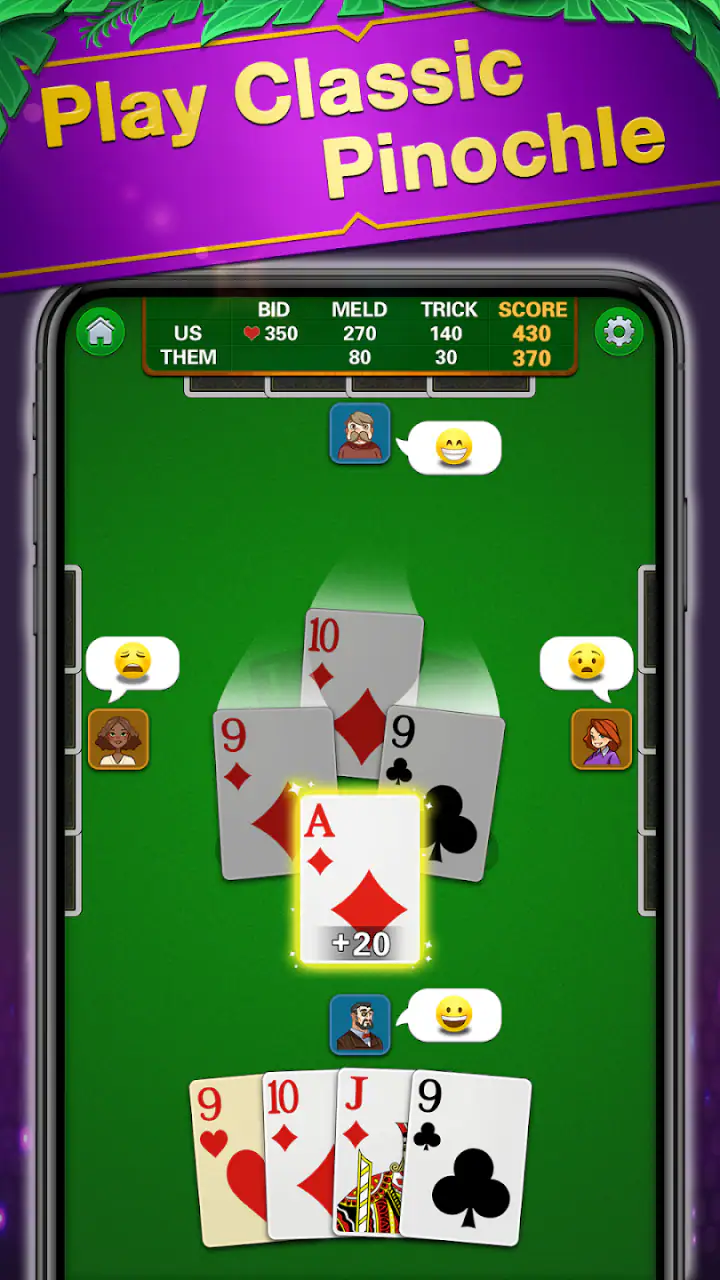
For newcomers, the first sessions may feel slower than expected. Players familiar with simpler trick-taking games might initially wonder why a move that appears obvious is not always best. My advice is to avoid judging the game after one short round. Give yourself time to recognize its rhythm, especially the relationship between early caution and late-round opportunities.
How I use the two modes in a normal day
A realistic use case is a split session. I might play offline while waiting for an appointment, using the short window to practice reading the hand without worrying about another person’s schedule. Later, when I have a stable connection and more time, I can move to online play for a match that feels less predictable. The two modes serve different purposes rather than competing with each other.
This also makes the game useful for households with different playing habits. Someone who wants a quiet solo game can use the offline option, while a more competitive player can seek the pressure of multiplayer. It is not necessary for every session to become a social event. That is a small but important distinction, because card-game apps often assume that the main value comes from competing against strangers.
I also find the offline option helpful for learning decision patterns. When I am still becoming comfortable with Pinochle, I would rather make mistakes against a computer-style opponent than immediately expose every uncertain move in a live match. After I understand the basic flow, online play becomes more appealing because I can test whether my decisions hold up against a less predictable opponent.
Where the game works best
The strongest setting for this title is a relaxed break where I want concentration without a large time commitment. It suits a player who can enjoy a few hands while sitting with a coffee, riding as a passenger, or winding down in the evening. The game does not need the visual intensity of an action title to hold attention; its interest comes from the changing card situation.
It is also a useful choice for people who already enjoy traditional card games but do not always have someone nearby to play with. The online mode can provide the human element, while offline play prevents the app from becoming useless when a connection is inconvenient. That combination gives it a broader everyday role than a game designed only for scheduled multiplayer sessions.
Families should still pay attention to the Everyone 10+ rating when deciding whether it suits younger players. The rating does not make it unsuitable for most older children or adults, but I would not treat it as a universal game for every age group. Its main audience is people who enjoy thinking through card choices, not players looking for a colorful arcade distraction.
For a group of friends, the best use may be comparing decisions after a hand rather than simply racing through matches. Pinochle creates natural discussion: why did one player hold a card, why did another take a trick early, and which choice changed the result? The app can support that kind of shared interest even when everyone is not sitting around the same physical table.
What playing online changes
Online multiplayer gives the game a stronger sense of consequence. Against another person, I cannot assume that a familiar pattern will repeat. A human may take a surprising risk, conceal a strong position, or make a mistake that changes the entire hand. That unpredictability is the main reason to choose online play over offline sessions once the rules feel comfortable.
There is also a trade-off. Live play is less forgiving of distractions. If I only have a minute or two, I would rather use offline mode than begin an online match and then need to leave. The flexibility of the app does not remove the basic responsibility of multiplayer: I should start a live game only when I can give it reasonable attention.
Players who dislike competing with strangers may find offline mode more comfortable, while those who want the strongest test of their decisions will probably prefer online sessions. Neither mode is automatically superior. The right choice depends on whether I am practicing, relaxing, or looking for a contest that can surprise me.
The trade-offs I noticed
The first limitation is the learning curve. Pinochle has a more deliberate feel than lightweight card games, and that can be a barrier for someone who wants instant understanding. I would not recommend it to a player who prefers games that explain themselves through a few obvious taps. Here, patience is part of the experience.
The second trade-off is that the online option changes the time commitment. Offline play is easy to fit around interruptions, but multiplayer is better when I can stay focused. This is not a flaw unique to this app, yet it affects how I would use it. A player who regularly loses connection or has unpredictable free time may spend more time preparing for a match than enjoying one.
The optional purchases are another consideration. The game is free to start, but additional items cost $1.99 each. I would approach those purchases cautiously and decide whether they actually improve my experience before spending. The free entry point makes it easy to test the game first, which is useful because the real question is not whether the app costs anything initially, but whether its style of play holds my attention.
The current version is 2.2, and the app has passed the point where I would view it as an untested first release. Still, version numbers alone do not change the core decision: this is a focused card game, not a broad collection of unrelated activities. If I want puzzles, casino-style variety, or several different card formats in one download, another app may serve me better.
Its scale is respectable, with over 100 thousand installs, but I would not choose it solely because many people have downloaded it. The more useful signal for me is whether its central style matches my habits. A large audience cannot make a thoughtful trick-taking game feel fast and casual if I personally prefer instant rounds.
Small habits that improve the experience
My first practical tip is to use offline play as a deliberate practice space rather than merely a backup for lost connectivity. I can focus on remembering which cards have appeared, notice when I play too aggressively, and review the result without the pressure of a live opponent. That turns a quiet session into a way of building better instincts.
Second, I would avoid treating every early trick as a chance to prove strength. Holding back can preserve options for later, especially when the hand is still difficult to read. The useful question is not only “Can I win this trick?” but also “What will winning this trick force me to reveal or spend?” That change in thinking is where the game becomes more interesting.
Third, I would reserve online matches for moments when I can finish a hand without rushing. The app’s flexibility makes it tempting to start a live game whenever there is a spare moment, but the offline mode is better for fragmented time. Separating practice and competition this way makes both modes more enjoyable.
Finally, I would use the rating and purchase information as a reason to try the free experience before buying anything. A 4.5 average from roughly 1.5 thousand ratings suggests that many players enjoy the formula, but card-game preferences are personal. I would first determine whether I like the pace, the decision-making, and the balance between solo and multiplayer play.
Who should choose it, and who should skip it
I think this is a strong choice for a player who wants a classic card game with both connected and disconnected play. It is especially appealing if I already enjoy trick-taking games, want to improve through repetition, or need something that can work during both online and offline parts of the day. The ability to practice privately and then compete socially gives the game a useful progression.
I would also recommend it to someone looking for a calmer alternative to competitive action games. There is still pressure in a close hand, but the pressure comes from decisions rather than reflexes. That makes it suitable for evening play or thoughtful breaks when I want my attention engaged without a noisy presentation.
I would skip it if my priority is instant action, elaborate progression, or a large variety of game types. I would also choose a simpler card app for a child who is not ready for a more strategic ruleset, even though this title carries an Everyone 10+ rating. And if I strongly dislike live competition, I would use the offline mode only after accepting that the game’s biggest long-term appeal may come from facing human opponents.
My recommendation after playing
Pinochle succeeds because its most useful feature has a real effect on how I can fit the game into daily life. Online play gives the classic format unpredictability and social tension, while offline play makes it dependable when I am alone, traveling, or still learning. That is more valuable than simply placing two modes in a menu; it lets me choose the kind of attention I have available.
Topy Games has kept the focus on the card experience rather than trying to turn it into something it is not. The result is a free, specific recommendation for people who enjoy patient decisions and replayable hands. I would start without making any optional purchase, spend time learning the offline rhythm, and then move to multiplayer when I wanted a more demanding test.
My final view is that this is not the right game for everyone, but it is a convincing pick for the right audience. Pinochle is at its best when I want a traditional card challenge that remains available whether I am connected or not. If that combination matches the way you play, it is worth trying; if you want quick, effortless entertainment, its thoughtful pace may feel more like work than relaxation.
FAQs for Pinochle
What is Pinochle, and how is the game played?
Pinochle is a classic trick-taking card game usually played with two, three, or four players, depending on the version offered. The game combines bidding, melds, and tricks: players first compete for the right to choose the contract, then score combinations of cards before playing hands to win tricks. The app generally explains the rules and guides new players through the basic gameplay.
Can beginners learn Pinochle easily?
Yes, although Pinochle can feel more complicated than standard card games because it includes bidding, card combinations, and changing strategies. The app is suitable for beginners if they take time to understand the scoring system and practice against computer opponents. A tutorial, help section, or practice mode can make the learning process much smoother before joining competitive matches.
Can I play Pinochle offline without an internet connection?
Many Pinochle apps allow offline play against artificial intelligence, which is useful when traveling or when you do not have a reliable connection. However, features such as online multiplayer, leaderboards, advertisements, cloud synchronization, or account-based progress may require internet access. Availability can vary by version, so checking the app’s feature description before downloading is recommended.
Does Pinochle support multiplayer games with friends?
Depending on the specific version, Pinochle may offer online multiplayer, private rooms, local play, or invitations through an account or social platform. Multiplayer features are particularly useful for players who already know the game and want to play with friends instead of computer opponents. Some modes may require registration, an internet connection, or in-app purchases, so review the listed requirements first.
Is Pinochle free to download and does it contain advertisements?
Pinochle is commonly available as a free download, but the exact business model depends on the developer and platform. A free version may include advertisements, optional purchases, premium tables, additional card designs, or an ad-removal upgrade. Before installing, check the store listing for in-app purchase information and privacy details, especially if the app will be used by children.
Pros
- Supports classic Pinochle rules for a familiar card-game experience.
- Helpful tutorials make it easier for new players to learn the basics.
- Quick rounds work well for short gaming sessions.
- Offline play is convenient when no internet connection is available.
- Simple controls make card selection easy on mobile screens.
Cons
- Limited visual customization may make long sessions feel repetitive.
- Computer opponents can feel predictable after extended play.
- Some features may require an internet connection or account access.
- Small text or card details may be difficult to read on compact screens.
- Ads can interrupt the experience in the free version.


